¶ Sunday 01.09.24 ( Max/ Barney/ Phoenix 97 Total )
¶ Camping Sokol Praha
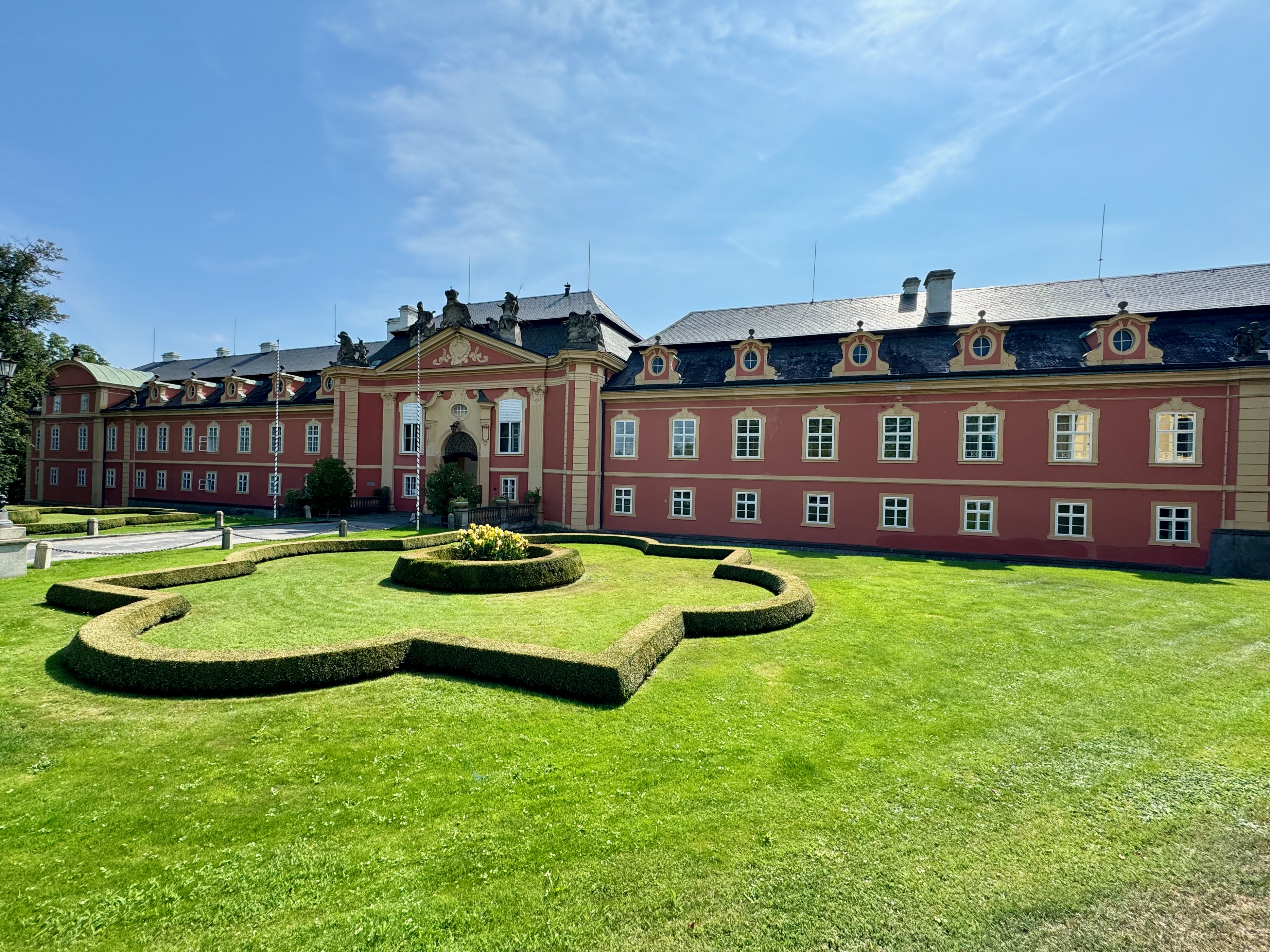
Our journey towards Prague took us through some pretty countryside and small villages. We are stopping en route to visit Dobříš Castle which is now a hotel but has some rooms open to the public, as well as beautiful gardens. Reconstruction of the castle took place between 1745 to 1765 by Heinrich Paul Mansfeld after a fire in 1720 almost completely destroyed it. His daughter, Isabella, later married into the Colloredo family in 1771 creating the Colloredo-Mannsfeld family which lived in Dobříš until 1942. The family were then whereby the castle, which was used as a summer residence, acquired its present appearance. Heinrich Paul’s daughter Isabella was married to Franz Gundakar Colloredo in 1771. This is how the Colloredo-Mannsfeld family came into being, which remained in Dobříš and were one of the noblest aristocratic families in the country. In 1942, when the family was expropriated by the German Reich. In 1945 the castle and family possessions were confiscated by the socialist Czechoslovak state and used as a home for writers. In 1998, Dobříš Castle returned to the family’s possession after the two of the descendants lodged restitution claims. Legal settlements regarding land ownership were only settled in the early 2000’s when this was divided between the two descendants. Since then, the castle has undergone extensive reconstructions. The current owner is Dipl. Ing. Jerome Colloredo-Mannsfeld.
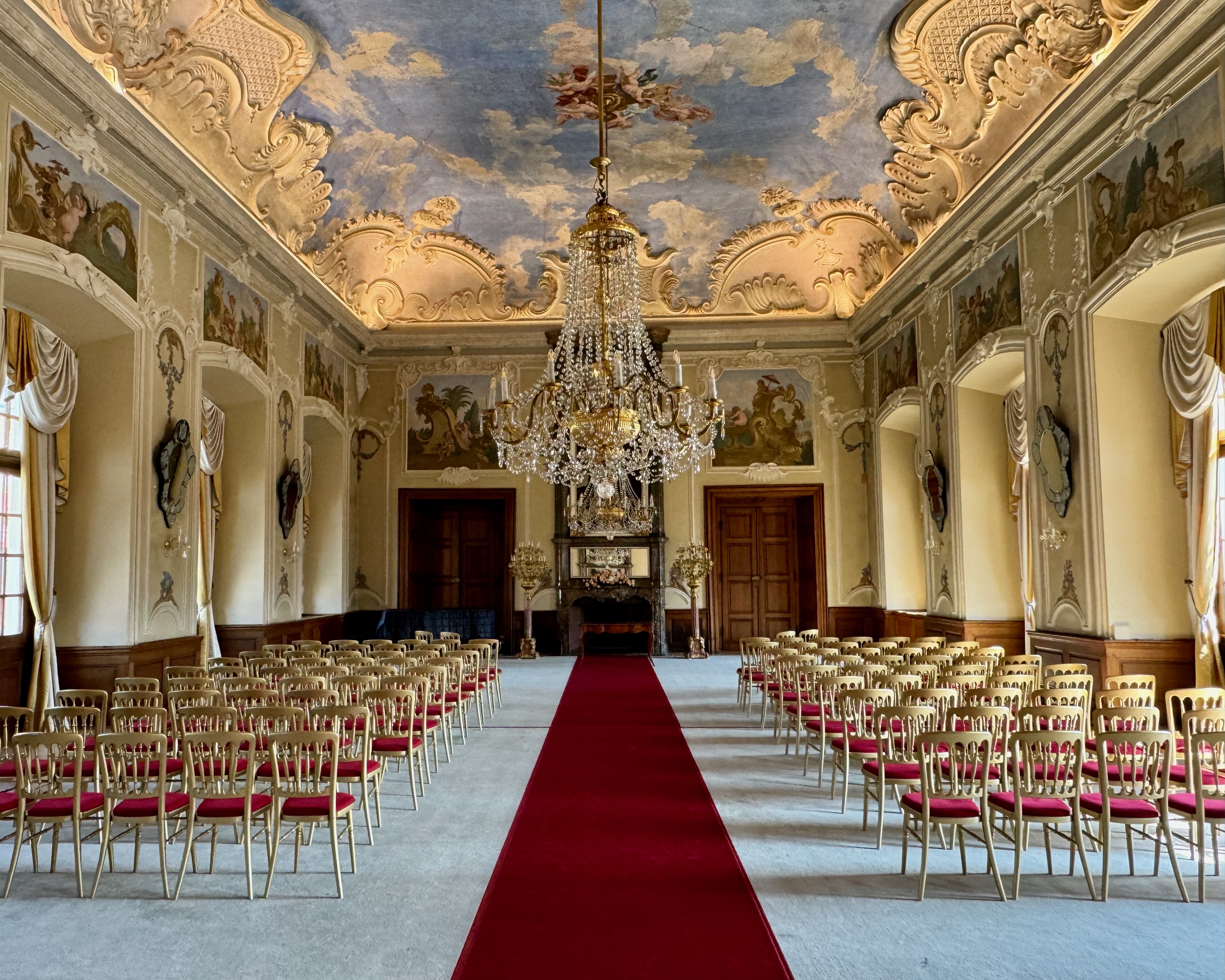
There are eleven rooms on show, and some of the exhibits and displays had English translation. On the staircase to the rooms hung three unicorn tapestries, and the stairs led up to the Mirror Hall. Today it is used for wedding ceremonies and concerts, and it reminded me of a the décor in a French chateau. The rooms are decorated in the Rococo and Baroque style complete with mannequins dressed in period costume. Most of the rooms contained family keepsakes including photographs and personal items, as well as information about the family history in relation to political events.
We then explored the gardens. The first garden is set out in the French Baroque style with symmetrical flower beds, terraces and hedges. It was no surprise to learn that it had been influenced by the design of the gardens at the Palace of Versailles near Paris. As you approach the orangery, there is a small courtyard area with an impressive fountain called "Watering Helios's Horses". At the rear of the garden, opposite the Castle, there is a huge orangery. In the last couple of years, the painting on the orangery (that give the illusion that has the same façade to reflect the Castle itself) has recently been completed, and it is stunning. It is only when you are close up that you discover not all is as it seems from a distance. The rooms inside the orangery have been developed with the next generation in mind – there are boards and interactive displays showing what nature can be seen in the grounds, trees bearing exotic fruits such as lemons and kumquats in the orangery itself, and a super indoor play area for children equipped with toys, a movie area and soft play. Outside there is an aviary and this leads onto the English garden with plenty of space for families to enjoy a picnic, or go for a walk together.
We left the castle then had a quick look around the small village, then headed onto our site a Prague. The site is situated near a lake (although we were not near the lake), and is in the town of Dolní Počernice. There is a swimming pool and small shop on site, and the facilities were immaculate. Travel into Prague by bus or train is easily accessible from the site. There is a supermarket (Billa) within walking distance of the site, as well as restaurants and a lovely park which we explored later in the day. We are looking forward to having some rest tomorrow after our journey as it is still hot.
¶ Monday 02.09.24 ( Max/ Barney/ Phoenix 98 Total )
¶ Camping Sokol Praha
After a hot and sticky night, we had a lazy morning then decided to take the train into Prague at about 2pm to visit St. Vitus Cathedral, hoping it may be a bit cooler then too. On our last whistle-stop visit, our guide had march us quickly past the castle and cathedral to the centre of the city so we did not get the opportunity to visit. The train into Prague takes about 10 minutes, then we walked into the centre of the city, and through the park, the took the many steps up to the castle. Again, the heat made this more of a challenge that it would normally have been! Kevin went to get tickets for us to visit the Cathedral, and these gave us access to the Castle, St. George’s Basilica and the Golden Lane, which we will visit tomorrow.

The Castle area was much quieter than when we were here last time, but there were still plenty of visitors inside the cathedral. We should have purchased the audio guide as there was little information around the Cathedral itself. The main aisle was closed to the public as restoration works were taking place inside. We were able to get a bit of information from an online app as we walked around. St. Vitus Cathedral has been used for coronations of Czech kings and queens, and the first church consecrated on this site was founded by Prince Wenceslas around 925. The Gothic cathedral we see today began it’s construction in 1344 but it was finally completed in the late 18th Century when the new dome was added. There is a main aisle surrounded by a series of individual chapels.
At the end of the side aisle is a huge silver tomb that overhangs the walking area. This huge mausoleum is sculpted in solid silver with angels holding heavy drapes above it. This is the tomb of the martyr, St. John of Nepomuk who has been sculpted in solid silver also wearing a halo of five stars with a sun on top. He was thrown into the Vltava from the Charles Bridge by the Roman Emperor (and Bohemian King) Wenceslaus in 1383 for failing to share the secret of Wenceslaus’s wife’s infidelity to the King. His body was pulled from the river in 1719 and encased in the tomb containing over two tons of silver, for his martyrdom, and remaining loyal to the Queen.
The stained-glass windows are very vivid and beautiful, and the Cathedral is impressive in height with it’s Gothic arched ceiling and columns, but we both agreed that we felt a little underwhelmed by it all. It didn’t have the grandeur of some of the cathedrals and churches we have visited, although there is no doubt that the exterior is magnificent, particularly as it stands on a hill overlooking the city of Prague. It was difficult to have a good look at the chapels as these were roped off, and a visitor pathway guided you through the cathedral. This in itself detracted from the building itself as there was no place to sit and reflect. One other thing I did not approve of was the ‘coin slot’ approach to lighting a candle for a loved one. You inserted a coin of some amount, and a battery- operated candle lit up for either 15 minutes or 30 minutes, depending on how much you had paid. I thought this was quite tasteless and very impersonal. The physical act of lighting a candle for a loved one is part of the process for me, as if you are bringing their light back into the world (if they have passed on), or into focus (if they are living) for a few moments as you think of them. This just seemed like a way of commercialising what should be a very private and personal moment. I did not see one person put a coin into one of these whilst we were in the Cathedral so perhaps others thought the same as I did.
We took a gentle stroll back down to the town, over the St. Charles Bridge, and into the market place. Kevin could not resist the famous Prague ‘chimney cake’, a cylindrical shaped roll of sweet dough coated in sugar and cinnamon, similar to a Danish pastry, and filled with ice-cream and fruit. It was huge! We stopped to look in a few shop windows on our way back to the station, where we caught the train back then walked to the campsite. We will return to Prague tomorrow for more sight-seeing.
¶ Tuesday 03.09.24 ( Max/ Barney/ Phoenix 99 Total )
¶ Camping Sokol Praha
Today is our last day in Prague. We took advantage of the site minibus which dropped us off at the railway station as we know we will have a lot of walking to do today. After our short train ride, we caught a tram (no. 22) to a stop above the castle so that we could walk down to it rather than up. This was really worthwhile as the views from above the castle over Prague were stunning. We arrived at the Castle just before 12 noon, and we noticed crowds were beginning to gather. We realised that we were just in time to witness the ceremonial changing of the guard and flag by the Military Office of the President of the Republic. Two guards stand at the entrance to the castle gates in sentry boxes (similar to the sentries at Buckingham Palace), and they are dressed immaculately in light blue uniforms (they did have a look of Captain Scarlett too though as they were wearing a smart flat cap and sunglasses!). A group of officers’ march across the courtyard through the gates and this is where the change takes place. This was a bit of a bonus as we hadn’t planned on seeing this.
We went to get our audio guide for the Castle but booked on an English tour with a guide instead. We met a lovely couple from Illinois whilst we were waiting, and they had lived in Durham for two years as her husband has worked for the Caterpillar factory (small world!). Unfortunately, although our guide was clearly very knowledgeable, she did have some problems with her throat during our tour, and it was difficult to hear what she was saying. She took us back in to the Cathedral so we did learn more about it, but we missed a lot too. One interesting fact I learned was that the American dollar evolved from the Czech tolar which were the first silver coins issued in 1520 from their silver mines.
We were able to access some areas more closely with our guide, such as the Chapel of St. Wenceslas, the patron saint of Czech lands where every coronation began. He is the subject of one of our most famous Christmas carols, and was murdered by his younger brother. It is not possible to enter the chapel, but we were able to see the detailed paintings, and precious stones inside. Inside the chapel is the door leading to the Crown Chamber where the Bohemian Coronation jewels are kept inside an iron safe. The safe has seven locks with keys held by the Czech President, the Prime Minister, and the Archbishop of Prague, amongst others. They must all be present to enable the safe to be opened.
I think we both expected to see more of the palace building but the main hall was huge, and it was interesting to hear from our guide that it had been used for horse events in the past. We visited St. George’s Basilica, the oldest surviving church building within Prague Castle founded in 920. It is a striking red and white stone building with two white towers. What a simple but beautiful place it is. The once adjacent convent is now used by the National Gallery for exhibiting Old Bohemian artworks. Our final place to visit was Golden Lane which dates back to the late 15th Century. The houses were originally used to house the castle guards. It is a series of small, colourful houses that were obviously built for people much smaller that we are today. It is steeped in myths and legends about the various people who lived there including writers, goldsmiths, a fortune-teller, and many families. The last residents moved out in 1953. The area was very busy as it is free to the public once the castle attractions are closed. It was quirky and we enjoyed looking around as best we could.
We headed back towards St. Charles’s Bridge where we were taking a historic boat ride on a replica Venice boat. An English commentary was provided using headphones (similar to the hop on/hop off buses) and we were taken along the River Vltava where we learned about different historical buildings and events. The viewpoint from the river is a unique one, and it is nice to take some time out to sit and enjoy the late afternoon in such a beautiful city. After briefly visiting the museum telling the story of the construction of the St. Charle’s Bridge, we walked back to the station to catch our train. On the way we experienced our first rain of the holiday which appeared out of the blue literally. Huge raindrops plopped onto the pavements and everyone looked surprised to see them as no rain was in the forecast. Still, it cooled the air briefly which was a relief.
We got back to the van at about half past 6 and I rang Mam and Dad for a catch up. I also got FaceTime messages from Dan, Jonny and Aurora as it was my birthday today. It was lovely to catch up with everyone and to share news. We are leaving tomorrow to travel to Linz for another exciting episode this holiday.
¶ Wednesday 04.09.24 ( Max/ Barney/ Phoenix 100 Total )
¶ Camping Linz
Today we are leaving the Czech Republic and heading south to Linz in Austria. It is another beautiful day, and we are glad to have had air conditioning on our journey down. We drove through the countryside via small towns and villages. There is not a main dual carriageway all the way down to Linz, but there is evidence of road building in different areas so the road is being developed. This means that we had to be careful to note changes in speed limits as we were passing through villages even though this is the main route to Austria.
The journey is not too long today – a couple of hours at most so we made a stop at the next main town which was about an hour from Linz, Ceske Budejovice. After a bit of trial and error, we located the motorhome parking close to centre of the city. After a short walk, close to the park and along narrow streets with attractive, old buildings in the Baroque style, we came to the market place. Ceske Budejovice is home to Budweiser brewery which was established in 1895. We picked up our trusty magnet, and had an ice-cream in the hot sunshine as we sauntered around the market place. One of the most popular tourist attractions is the Black Tower which was built between 1550 and 1577 as a belfry and watch tower to guard the city from the risk of fire. The tower guard and his family lived in the tower, and he would warn the people of any fires by raising a red flag or ringing the bell. Later, a telephone was available to ring the fire station! Kevin walked up the 227 mostly wooden steps and was rewarded with a fantastic view across the city and surrounding countryside. Next to the tower is the Cathedral of St. Nicholas, with some parts dating back to the 14th Century, which was unfortunately closed today. There is a lovely town hall with a clock tower in the market place, as well as an impressive Baroque fountain – ‘The Samson Fountain’ – which was build after the Thirty Years War as part of the city renovations between 1720-1727. We were pleased that we had time to visit here today as it was a worthwhile visit. Our first motorhome visit to the Czech Republic has been a very pleasant one. The rest of the journey to Linz was quite straightforward and we were soon on our pitch and trying to cool down on another hot and sticky day. Tomorrow is a rest day at last! Hooray!
¶ Thursday 05.09.24 ( Max/ Barney/ Phoenix 101 Total )
¶ Camping Linz
We did go out today and a little adventure to find the local camping shop for a couple things we needed for the van. On our way back to the site we did some food shopping at Lidl (I know … but it’s not the same as at home!). When we returned to the site just before 2pm, the gate and Reception area were closed so we had to have our lunch in the car park opposite until we could get on to our pitch. Kevin wasn’t given all the information when we arrived yesterday as there was a mix up with our booking and we hadn’t been allocated a pitch, even though we’d had confirmation of our booking). Kevin said this sent the receptionist into a bit of a fluster as she tried to solve the problem and sort us out a space. The site has a lot of permanent caravanners who are pitched up with their usual lighting, plastic fencing and flower tubs, but the site is quiet despite being close to the motorway, and the facilities are nice and clean. We spent the afternoon doing our own thing – and watched a bit of TV in the evening. It has been hot today too but the wind has been quite strong. We both awoke a couple of times as the acorns on the oak tree above us fell onto our roof and bounced around. The breeze has been very welcome though.
¶ Friday 06.09.24 ( Max/ Barney/ Phoenix 102 Total )
¶ Camping Linz
It was much cooler and cloudy when we woke this morning, which was quite refreshing. We are visiting the city of Linz today and caught a bus just after 10am. We are planning on visiting two places today – Mariendom (St. Mary’s Cathedral) Linz (the largest cathedral in Austria with a capacity of 20000), and Linz’s local mountain, Pöstlingberg. The bus journey to the railway station took about 20 minutes, and we then walked through the streets towards the Mariendom. There is a greater mix of old and new buildings as you walk towards the church.
We did not know much about the history of the city, particularly during the Second World War, but Linz suffered 22 air raids by the Allies in 1944-1945 which caused a huge amount of destruction. Hitler’s original aim was to expand the city, after making it a ‘Fuhrer City’ as he had spent his youth hear. He wanted to make it the cultural capital of Nazi Germany that would overshadow Vienna, and the place he would retire to, but none of this ever transpired. During WWII, Linz became the hub for the armaments industry. The Mauthausen concentration camp was established 12 miles east of Linz in 1939, and three further sub-camps were added in the surrounding area to house prisoners – mainly men, but also women and children from 1944. When the camps were liberated by the Americans in 1945, they housed more than 85000 prisoners.
The Mariendom church has the largest capacity of any in Austria, but it’s spire is not the tallest as no churches can have spires higher than the one in Vienna. What this cathedral does have is the most incredible stained-glass windows. Every window has stained-glass and, though this makes the interior quite dark (a criticism of the design), it makes it very atmospheric and gives it a presence that I did not feel if St. Vitus in Prague. When we visited today there was a sound installation which was part of the European Capital of Culture year 2024 called ‘Silent Echoes’. Large screens around the church displayed images of the Dachstein glacier Dachstein Glacier which is located between the towns of Ramsau am Dachstein in the south and Hallstatt and Obertraun in the north, in Austria. Sounds from the glacier combined with sounds from bells of Notre Dame Cathedral in Paris filled the church as we walked around. The installation aims to highlight the fragility of nature and the church due to human influence – the increasing retreat of the glacier due to global warming, and the cultural changes facing the church represented by the fire that threatened the collapse of Notre Dame Cathedral in 2019. The Cathedral is famous for the Linz window which depicts the history of the city.
After spending time in the Cathedral, we walked to the market square where we took the tram up to Pöstlingberg, which is a high hill overlooking the city and the Danube river, and is 541m high. The tram climbs up the narrow track stopping at various points on the way up. We were surprised just how many houses there were creating a unique residential area in the city. At the top is the Pilgrimage Church which has two white towers that can be seen on the way up the hill, as well as from certain points in the city. The church was built in 1748, and the interior is ornate with gold decoration and a striking black and gold pulpit (we couldn’t see how the priest would get into it though). In contrast, a new organ was installed at the back of the church in 2022 and this looks very modern. Kevin was intrigued by the few organ pipes leaning against the wall below – was this like having a handful of screws left over when you have built something?
Outside we went down to the viewing platform which gave a magnificent view of the city as a whole, the meandering Danube, and the countryside and mountains in the distance. It was cloudier and more hazy today but we still managed to take some photo and capture the view. Pöstlingberg is also famous for the Grottenbahn, or Grotto Train. The original track dates back to 1897 but it was in 1906 when the dragon train started to be used as a fairytale ride. Originally passengers enjoyed travelling 4 times around the grotto, and each time the lighting was used to show different characters from stories of gnomes, dwarves and dragons. The fourth time round was in darkness. Today passengers are taken around three times (no journey in the complete darkness!). After the train ride, passengers walk to a small town with side displays showing scenes from a variety of well-known tales such as Sleeping Beauty and Red Riding Hood. There were also several Austrian tales that we were unfamiliar with. I am not sure what children today will think of it all – all of the scenes date back to a more innocent time (though some of the story characters are quite scary) and there was no additional technology that children would expect to find such as interactive displays or animation. It is a very nostalgic experience that takes you back to a time when children were allowed to be children, and where children had to use their own imagination to tell stories. Still, the young children that were on the dragon train seemed to enjoy the experience so it was good to support it for future generations to visit.
We walked to the café that overlooked the city and stopped for coffee, and a piece of Linzen Torte which we decided we’d try on our visit. We hardly ever do this as we usually pack up our lunch or eat in the van, so it was a really nice treat with a lovely view. We took the tram back down to the Market Square then headed back to the bus station. We visited the Old Cathedral on our way, and then made our way to the bus stop. Another lovely day with lots to see.
¶ Saturday 07.09.24 ( Max/ Barney/ Phoenix 103 Total )
¶ Donau Park Camping, Klosterneuberg, Vienna, Austria
We have had a change of plan due to the weather forecast, and have decided to travel to Vienna for our next stop, and not Hallstatt as originally planned. Rain is forecast and, as most of the things we would have wanted to do in Hallstatt were outdoors, we decided to travel to Vienna where there are plenty of places to visit indoors.
On our way to Vienna, we stopped to visit Schallerburg Castle which is about an hour away to the west of the city. We also spotted another place to visit at another time in Melk – Melk Abbey – which looked magnificent in the distance as we travelled along the A1.
We were able to park in the castle car park (this may have not been the case if we had come during the school holiday period(, and we walked up towards the castle – a short, gentle slope but nowhere near as challenging as Hohenzollern or Neuschwanstein. The first castle was built here about 100 years ago, and parts of the original castle wall still exist. There is a unique, two-storey terracotta courtyard decorated with 1600 figures from Ancient Greek and Roman myths.
The castle opened to visitors in 1974 and has held a different exhibition within the Renaissance castle since then. The current exhibition ‘RENAISSANCE, Here, Now and Then’ was a really interesting one, and it tied in the beginning of the Renaissance period to the events of the castle. The exhibition is set in a series of rooms within the castle and was really well done with just the right amount of reading and artefacts to give visitors bite-size chunks of information without overloading the brain. Significant pieces of information included the rise of the portrait which were used as status symbols to convey wealth and beauty. Artists were encouraged to ensure that their subjects were seen in the best possible light, ignoring imperfections and painting their clothing to look fashionable and expensive. How similar is that to the social media influencers of today and their need to use filters, and also to portray a particular lifestyle of success and happiness? It was thought-provoking to compare the two periods of history in this way.
Whilst there are very few portraits of those who lived in the castle, particularly of the women, there was a portrait of Hans Wilhelm von Losenstein, son of Christoph von Losenstein (who began remodelling the medieval castle in 1540). It was Hans Wilhelm who transformed it into a magnificent Renaissance castle and gardens, deeply rooted in his Protestant faith, and also his own High School which was the wish of his father. The unique curriculum was inspired by Hans Wilhelm’s personal tour of many foreign countries with his older brother for 8 years. During this time, he studied the Renaissance style in Italy. His father’s aim was to build a school for the citizens of Loosdorf and the young men of nobles within the surrounding area, and Hans Wilhelm fulfilled that ambition in 1574. The exhibition touched on aspects of the education that had begun to interest scholars at that time – alchemy, botany, Latin, poetry, history, arithmetic, the arts and philosophy.
Another aspect of the exhibition showed how the development of the printing press, and access to publications such as newspapers and books, were seen as an integral part of educating people, and for sharing and spreading knowledge. There were samples of front pages of newspapers with headlines referring to floods and comets affecting places such as Nuremberg and Salzburg, and the images were of course all hand drawn and painted at this time. Hans Wilhelm’s tomb was moved from Loosdorf chapel to the castle chapel, and can be seen today, and has a full-size sculpture of him lying in full armour on the casket. Sadly, despite his good work, Hans Wilhelm was lavish and owed a great deal of money upon his death which the extended family were never able to recover from.
We visited the oldest part of the castle then walked around the garden which was full of apple trees and pretty flower beds, then headed back to the van for some lunch before heading to Vienna.
The satnav took us through lots of towns and villages for the next part of our journey rather than along the A1. Some of these were quite narrow so it was not as relaxing for Kevin to drive this second part of the journey. We arrived at the site at about 4pm. It is situated in the town of Klosterneuberg which has a magnificent abbey on the hill overlooking the town. We are within walking distance of the town, the train station and buses so this is a good place to be. Pitches here are smaller than some, but there is a small shop, restaurant and spotless facilities on site. The town is just a few minutes from the campsite with a local Spar and other shops. We called into the Spar to get juice then walked up to the abbey which is really beautiful and huge. We are not sure if we will get to visit to see inside though as the opening times are limited to half days Mondays and Thursdays. We walked back to chill for a bit, and then had tea. Tomorrow is definitely a rest day as it is going to be in the 30’s again so too hot for sight-seeing. Then we have a Vienna Pass for three days of sightseeing from Monday to Wednesday when it is cooler (and rainy).
We will have to stop visiting places on travel days as I can’t keep up with our travel journal!
¶ Sunday 08.09.24 ( Max/ Barney/ Phoenix 104 Total )
¶ Donau Park Camping, Klosterneuberg, Vienna, Austria
We are having a rest day today as we are expecting temperatures of 30º+ and that is just too hot for a full day of sightseeing. Instead, we have done our best to keep cool! We went for a walk with view to buying a few extra groceries but, for the first time ever, we discovered everything was closed. Luckily, we always carry some of the half-baked bread rolls with us so we were able to have a sandwich for lunch anyway.
We are planning to go into Vienna for the next three days using our Vienna Passes, so we spent the rest of the afternoon planning what we wanted to visit each day. It was a good job we did this as some of the things we want to do (such as the river boat cruise) have to be pre-booked online, and cannot be booked at the venue on the day. As rain is forecast tomorrow, we have planned some indoor visits, and will also use the Hop-on, Hop-off buses which are part of our Vienna Pass.
We had a FaceTime with Dan, and caught up with his news. He is playing on Sister Act in Darlington this coming week so is staying at home. He has been so busy – we hope that he can get some time off before he heads off on his tour in Germany and Austria for 6 months with the musical ‘Grease’.
It really was a hot and sticky day, and a very hot night – at 2am the outside temperature was still around 26º and, as we were expecting it to rain in the early hours, we had to close the top window so it was hotter again inside the van! We both had a restless night as a result.
¶ Monday 09.09.24 ( Max/ Barney/ Phoenix 105 Total )
¶ Donau Park Camping, Klosterneuberg, Vienna, Austria
We woke to very heavy rain and decided it was best to change our plans for today. We are going to postpone our trip to Vienna, and are extending our stay here for an extra day so that we can use our three-day pass from tomorrow instead. It seemed pointless even trying to sight-see in such heavy rain that was with us for most of the day. Instead, we both got on with some other things – I did some work for my Crafty Kitz business and sent some emails, and Kevin has been organising our holiday photos. He has also begun to insert them into our online travel journal.
I went for a nice hot shower this afternoon when everything was quiet and, when the rain started to ease off this afternoon, we went to pick up a few groceries to keep us going for a few days. I am struggling with the amount of processed food that is predominantly sold in shops this time as it just doesn’t agree with me. My diet has changed so much over the last year but it is not possible to buy vegetables in smaller quantities that we can store in the fridge, and they are too expensive to waste. We will have to consider how we can get around this if we return for a holiday in Europe next year.
We made a bit of an itinerary for visiting Vienna over the next three days using our Vienna Pass. This Pass is similar to the one we got in Salzburg last year, and it gives free admission to many attractions in and around the city.
We are looking forward to going into Vienna tomorrow, especially as the sun is returning.
¶ Tuesday 10.09.24 ( Max/ Barney/ Phoenix 106 Total )
¶ Donau Park Camping, Klosterneuberg, Vienna, Austria
We took the train to the city centre this morning. The station is just a few minutes from the campsite and you can buy tickets on the platform. After four stops we changed to the U Bahn and got off at Schwedenplatz. We are catching the Hop On, Hop Off bus on the Blue line so that we can get our bearings. We stayed on the bus for about an hour, and got off at the Vienna State Opera House as we had booked a tour there later in the afternoon and just wanted to see where we needed to be.
We then travelled on the U Bahn to Schonbrunn Palace to get our tickets for tomorrow. The sun was shining but there were quite big clouds in the sky too. Schonbrunn Palace is vast – there are so many things to see there and we won’t have time to visit them all this time. We booked upgraded our Vienna Pass tickets so that we could do the Grand Tour of the Palace which included additional rooms. After eating our lunch, we headed back to the Opera House ready for our tour. We caught the Hop On Hop Off bus (Yellow line) just across the road from the Palace.
The Vienna State Opera House is another building that suffered much destruction from Allied bombings during the Second World War. Originally completed in 1869 in the Neo-Renaissance style, the stage, auditorium and side staircases were completely destroyed by bombings. Fire hydrants were also hit so water was not available to extinguish the fires inside, and the roof collapsed as a result. Only the front façade, Grand Staircase, Tea Salon and the Schwind Foyer remained – the rest of the opera house was a ruin. During the Nazi regime, many performers were forced to leave, were persecuted and/or killed, and performances of some works were banned. It took ten years to rebuild the State Opera House, and it finally reopened in 1955 with a performance of Beethoven’s ‘Fidelio’.
The opera house was extremely busy with guided tours in several languages, and these are only offered between 2.30pm and 3.15pm daily. For that reason, we felt as if we were rushed through as there was always another group waiting to come into the area we were in. Our guide was very knowledgeable, but it was difficult to take in everything when we were trying our best to take photos as well. We were given information about the Vienna Ball which began in 1935. We watched a short video showing how all of the seats are removed from the auditorium, and how a parquet floor is laid right into the stage area for dancing.
The original part of the building is extremely beautifully and very ornate – exactly what we were expecting. There were many frescoes, ornate decoration and huge chandeliers were like something you would see in a grand palace. The Schwind Foyer contains busts of classical composers whose works have been performed here, as well as those of renowned conductors. Originally used as for distinguished guests, and those who paid the highest price for tickets, the Foyer is now used by all who attend performances at the Opera House. The Tea Salon was originally built for use by the Austrian emperor for special occasions. We could not actually go into the room as it is now only available for private hire or for special occasions, and has been used for press conferences, interviews and award ceremonies.
After seeing all of this grandeur, we had very high expectations for the auditorium itself … but we both agreed that that was an anticlimax. The auditorium was quite plain in comparison and lacked the opulence that the entrance and Schwind Foyer suggest. It has a capacity of 2284 people, including a standing only area. The ground floor level is set out like the stalls of a theatre but the upper three floors comprise of individual boxes, each holding up to 8 people. There is a large seated, central balcony as well. Each seat has a screen which displays translation information for theatre goers during the performances. The opera season was about to begin and there was much work going on on the stage which I found much more interesting as scenery and staging were being put in place. The stage is huge, and the orchestra pit can hold approximately 110 musicians. After spending a few minutes in the auditorium, we were taken back to the entrance where the tour ended. It was very much a ‘whistle-stop tour’ however, if that is the only way to see inside then it is worth it – and it was free with the Vienna Pass.
Next we walked to City Cruises as we had booked a boat cruise along the Danube canal which runs through Vienna and eventually joins the river. On the way, we got our first glimpse of St. Stephen’s Cathedral – can’t wait to go inside over the next couple of days. The cruise and the train journey into Vienna take the same route. There was food and drink available on the boat. This trip was also free with the Vienna Pass, and at 31 Euros per person, we were pleased we had not paid for it. The trip offered nothing other than a view of the vast array of graffiti along the river bank - which we have got used to seeing during our trips to Germany – and industrial buildings, together with apartment blocks. The trip did not continue into the Danube but returned after reaching the end of the canal. Apart from that, there was very little to see on the ‘cruise’, and we were glad not to have paid 62 Euros for the hour and a half trip as it was uninspiring as it passed nothing of any interest or significance.
We walked from the boat towards Mythos Mozart – a multimedia experience about the composer and his works – as we knew they were open until 8pm. Unfortunately, it was closed on the Tuesday for maintenance of the experience so we will go tomorrow or Thursday. We made our way back to the site and just chilled for the rest of the evening. We are walking so much which is healthy!
¶ Wednesday 11.09.24 ( Max/ Barney/ Phoenix 107 Total )
¶ Donau Park Camping, Klosterneuberg, Vienna, Austria
Day 2 in Vienna started with our journey into the city. Our first stop today was Mozarthaus, Domgasse 5, which is just around the corner from St. Stephen’s Cathedral. Although Mozart lived in many apartments during his time in Vienna, this is the only one that still exists, and where he is composed his greatest amount of music between 1784 and 1787, including the Marriage of Figaro and Don Giovanni. The museum was set out on several floors, very similar to that of his father’s museum in Augsburg, and Beethoven’s apartment in Bonn. The audio guide was excellent – just enough information to absorb without being overloaded. The exhibition rooms were set out in an interesting way where visitors learned about Mozart’s family, his contemporaries and his operas. There were some unique exhibits including an exhibition of how Mozart’s experiences of food and drink were reflected in his operas. The museum was keen to stress that the information was based on actual documentation rather than hearsay. Mozart’s observations of the social and cultural etiquette influenced the development of operatic scenes. Another interesting exhibit was a beautiful musical clock that plays a tune especially composed for it by Mozart. Samples of the wall decoration dating back to Mozart’s era have been uncovered in one room and, in another, there is a decorative stucco ceiling with stucco decoration on the walls to imitate marble columns. We both enjoyed our visit to this museum, and we are going to rewatch the film ‘Amadeus’ over the next couple of days, as extracts were shown to give an impression of what the apartment would have looked like during Mozart’s time there (the film was not shot in Vienna though).
After visiting Mozarthaus, we made our way to Schonbrunn Palace. We picked up some snacks in a shop at Schonbrunn, then ate our lunch in the park before going into the Palace. Our tickets were timed, and the Palace was very busy with groups of visitors. Schonbrunn means ‘beautiful spring’ and its history spans more than 300 years, beginning with the building of a mansion in the Middle Ages in 1589. It belonged to the manor of the abbey at Klosterneuberg (which is close to our campsite). Schonbrunn Palace was the summer residence of the Hapsburg Dynasty, although later members of the dynasty lived there. The Hapsburgs were the German Royal family, and were one of the chief dynasties of Europe from the 15th to the 20th century. As dukes, archdukes, and emperors, the Habsburgs ruled Austria from 1282 until 1918. Queen Elizabeth II was a distant relation of the Hapsburg family.
On the tour we were introduced to different generations of the family, and the rooms reflected different periods including information about Empress Maria Theresa and Emperor Francis I, who we learned were the parents of Marie Antoinette, who later married the Sun King, Louis XVI. The Empress had 13 children but only 10 lived until adulthood. Empress Maria Therea became the sovereign after the death of her father, Emperor Charles VI in 1740, and she ruled for 40 years until her death in 1780.
We also learned about Emperor Franz Joseph I (great, great grandson of Empress Maria Theresa) and his wife, Elisabeth (known as Sisi). Elisabeth became Empress of Austria and Queen of Hungary. after her marriage to Franz Joseph in 1854. Their marriage was not a happy one – their first daughter died in infancy, their only son committed suicide, and Sisi was assassinated in 1898. Franz Joseph died in 1916 and, despite their marital difficulties, he never recovered from the loss of his wife. Sisi was also very young when they married – just 16 – and did not adapt to life as an Empress. She often spent time away from her husband as a way of managing her health, and a dominant mother-in-law.
We visited many rooms on the tour, which included an audio guide. There are always some significant rooms that you remember that are different to anywhere else. For me it was the Porcelain Room which was Empress Maria Theresa’s private writing room. It was decorated in blue and white
Porcelain mouldings and decorative panels with painting in the same colours framed and hung within the panels. Members of the family contributed to these. adding a personal touch to the room. For Kevin it was the Mirror Hall. It is believed that it was in this room that Mozart, aged 6, gave a concert for Maria Theresa in 1762. His father Leopold recalled that, after Mozart had finished, he jumped onto the lap of the Empress, put his arms around her neck and kissed her!
Like many of these huge palaces, it is impossible to take everything in on the audio tour, and it would probably be worth visiting again. After the tour, we walked through the gardens to the Schonbrunn Zoo where I was hoping to see the pandas. I think we should take every opportunity we can to see these animals as they are so close to extinction – I hope Aurora and Lavender both get to see pandas somewhere in the world during their lifetime. The zoo has successfully bred pandas, with the birth of twins last year.
The zoo is in a beautiful setting, and within a natural landscape of trees and plants. It is world’s oldest zoo, and is home to more than 700 different animal species including pandas, polar and koala bears, elephants, giraffes, lions and tigers. We headed for the panda enclosure but were unlucky – no pandas in sight! We then noticed a large transportation crate outside and could just see a panda inside. After watching how the pandas at Edinburgh were prepared for their return to China a couple of years ago, I wondered if these pandas were about to make the journey back home to China too. We found out later that they are indeed returning there this Autumn and, after the panda enclosure has been remodelled, two new bears will arrive at the zoo.
We walked past the giraffe house, which was such a great place for them to walk around and eat the leaves on the trees as they would in the wild, and went up to see the polar bear. We were running out of time to see much else as we were there close to closing time, but I would love to go back there.
It is impossible to see all that Schonbrunn has to offer in just one day, and we would need to spend more time there if we return to Vienna. We didn’t have time to explore the gardens, the Imperial Carriage Museum, the Palm House, or to get up close to the Gloriette.
We headed back to camp for tea, and waited for the rain to come. Heavy rain is forecast tomorrow so our places to visit are all inside.
¶ Thursday 12.09.24 ( Max/ Barney/ Phoenix 108 Total )
¶ Donau Park Camping, Klosterneuberg, Vienna, Austria
Day 3 in Vienna. It has been raining quite heavily overnight and we are expecting a very wet day in Vienna today. We caught the train to Schwedenplatz, then walked up to Mythos Mozart. We passed St. Stephen’s Cathedral today. It was breathtaking, and I felt quite emotional when we went inside as the organ was playing. We were unable to walk up the aisle or up to the altar so we decided went on to our next stop – Mythos Mozart.
Mythos Mozart is a multi-media experience that fully immerses visitors in Mozart’s world using visual and audio to create the environment he was working in during his time in Vienna. There are a series of five rooms which take you through different aspects of Mozart’s time in Vienna. The music and visual environment that has been created gives a really unique insight into Mozart’s life in Vienna. Although he died at the age of 35, Mozart’s music still continues to be performed all over the world, and is perhaps more popular that it was even during his lifetime. The final room brings together wealth of data using AI to reproduce images of album covers that have been created from the early recordings to modern day performances by some of the world’s greatest orchestras. It also draws together images of Mozart using paintings and portraits that transform from one to another. It really is an incredible piece of art using the most advanced technology, and it highlights the huge impact Mozart had, and continues to have on music, composers and musicians today. It was really good to do something different, and we both felt this was a brilliant experience – and a great way to introduce young people to classical music. A great start to our third day in Vienna.
We walked back to St. Stephen’s Cathedral, and were able to get an audio guide and tour the whole cathedral. It really is a truly breathtaking cathedral with gothic arches and columns, and may be the most beautiful one we have visited to date. What I found interesting was that, although there were stained glass windows, they were not ornate with scenes from the bible, or of saints and biblical scenes. They were made up of squares of pastel coloured glass which created a soft light around the cathedral. Because the interior of the cathedral is so magnificent, there was no need for the windows to be ornate at all.
The audio guide was really good with clear markers around the cathedral of where to stop and listen. Both Mozart and Haydn were married in this church, and two of Mozart’s children were also baptised here. Mozart’s funeral also took place here. It is impossible to really describe the beauty of St. Catherine’s Chapel - the baptism chapel - and its ornate marble font which is carved in such incredible detail including the 12 apostles, and Jesus with the angels above him. At the Wiener Neustädter Altar to the left of the main altar, there are two intricate triptychs which depict scenes from the life of Mary, including the birth of Jesus. Kings, queens and emperors of Austria are buried here in the crypt. I really think this is perhaps the most magnificent cathedrals we have ever visited.
It was raining quite heavily when we left the cathedral. We decided to head for the MuseumsQuartier so that we could see the large dinosaur skeletons there. Our walking route took us past St. Peter’s Church, a Baroque Roman Catholic church built in the 1700’s. Records of a church of St. Peter’s date back to 1137. It is typical of a Roman Catholic church from that period, but has been renovated in the last 20 years which has given the restored paintings much more impact. There arehuge amounts of gold stucco and gilded décor including a gold pulpit. There is an ornate domed ceiling covered with painted frescoes depicting biblical figures. The dome has a series of arched windows all around it and, underneath, a series of round windows with decorative frescoes in between. These allow a great deal of light into the church below, and also cast light onto the decorative ceilings, painting and mouldings. The altar includes marble statues and paintings depicting the healing of the lame by St. Peter and St. John in Jerusalem. Often churches from this era can appear drab and unloved as the ornamentation is covered in years of dust and cobwebs, and the artefacts can then produce a stale, musty smell which is such a shame. This was not the case here – the church was immaculate, and was another gem in Vienna.
The rain continued as we walked towards the Imperial Palace, Hofburg. Outside the entrance there are remains of a Roman bath house that were discovered in 1990, and date back more than 1500 years. Inside the palace you can visit the Sisi Museum, the Spanish Riding School, the Imperial Apartments, Treasury and Silver Collection. The buildings here are majestic, and the Palace has more than 2600 rooms (that’s one long audio guide!). We continued on towards the museum, and thought we would try and find the venue that Dan is playing in on his European tour of ‘Grease’ when in Vienna. We walked through the gardens past the National History Museum on one side and the Art History Museum opposite, both of which are identical buildings constructed between 1871 and 1891. A few minutes’ walk away we found the Kunsthalle where Dan will be during his two weeks in Vienna, and we stopped to take a couple of photos and sent them to him.
We were both hungry so found a bench to sit on for our packed lunch. It was really cold, and was still raining so we decided to have lunch in the Natural History Museum instead. The entrance to the museum is very grand and, inside, it has a central white marble staircase and large dome which is 40m above the ground floor. The entrance and upper floors are decorated with marble statues and decoration, and we were expecting ‘grand’ prices in the restaurant too. This is located below the central dome, and was like something out of ‘Downton Abbey’! Actually, we were surprised at how reasonable the menu prices were. We both chose a Caesar salad and coffee, and it was beautifully presented when it came. It was also delicious, and a real treat for us as we rarely eat out on holiday. We agreed that it was much better than sitting outside in the rain on a park bench, like two down-and-outs, eating a cheese sandwich out of a plastic bag!
We went to visit the dinosaur section of the museum so that we could take photos of the animatronic Allosaurus, a full-size Pteranodon, and a full-size skeleton of a Diplodocus – all especially for Aurora. We then caught the Hop On, Hop Off bus outside the museum and got off at the Stadt Park so we could follow the trail of the statues of composers. It really was cold by now, and the rain was getting heavier. We found Schubert, and a gold statue of Johann Strauss playing the violin then made our way to the House of Music.
The House of Music is an interactive museum that gives visitors the opportunity to interact with sound by exploring the different elements as well as learning about some of the greatest composers that lived and worked in Vienna – Mozart, Beethoven, Haydn, Strauss, Schubert etc. As you make your way to the first floor, you can walk along an interactive keyboard that forms part of the stairway. The notes are displayed on a huge stave that runs along the staircase. We walked through the interactive section on the first floor, but had really come to visit the composer rooms on the next floor. I think by this time in the day – almost 6pm – we had become weary and it was harder to focus on everything that was on display. An audio guide would have been really useful in the composer rooms as they all had a huge amount of text to read on interactive display boards, and it would have been easier to listen to this whilst viewing the exhibits in the room. Artefacts included a pair of Schubert’s glasses, and some lovely examples of ladies’ dance which were a popular Viennese tradition, especially at balls where the music of Johann Strauss was played. Kevin discovered that Haydn’s head was severed and the head was stolen from his grave shortly after his death by two men who wanted to explore the anatomy of his skull. The skull was rediscovered after it was passed from one person to another until 1954, when it was reunited with the rest of his body and placed in his tomb.
We took the train back to the site. The weather had really taken a turn for the worst, and there were train announcements about a yellow warning for rain overnight and the tomorrow, and to expect travel disruption. Little did we know then what was to come …
¶ Friday 13.09.24 ( Max/ Barney/ Phoenix 109 Total )
¶ Azur Camping, Regensburg, Germany
We start our long journey northwards today as we leave Vienna and head to Regensburg, just south of Nuremberg. The rain has been torrential overnight, and there were huge puddles around the site. It wasn’t pleasant for Kevin to pack us up and get us ready to leave in all the rain. The news was beginning to report concerns about flooding in the Czech Republic, including Prague where flood defences had been put in place near the Old Town. When Kevin set the route in the SAT NAV, it came up with a snow warning in Austria which we found astounding after we had had 30ºtemperatures only 4 days earlier! Our journey to Regensburg was almost all in torrential rain with lots of surface water on the roads and motorways. There was increasing news coverage about flooding in Romania, Croatia, Austria, Poland and the Czech Republic. Many areas were experiencing rivers bursting into towns and villages, dams bursting, and the River Danube was at dangerously high levels in places.
When we arrived at Regensburg, the receptionist told Kevin that people arriving from Austria had driven through snow! The news coverage reported that some people had died or were missing in the floods in the Czech Republic, Poland and Romania, and that Vienna had begun to experience flooding on the UBahn and train lines due to the sudden rise of water levels in the Danube Canal. The rain became less heavy so we were able to walk to the supermarket to get our provisions for the next three days. We haven’t come prepared for such wet weather so we are drying out coats and trousers after being outside. We are glad to have headed north as the weather reports are for more rain and snow to come.
¶ Saturday 14.09.24 ( Max/ Barney/ Phoenix 110 Total )
¶ Azur Camping, Regensburg, Germany
The heavy rain has been relentless overnight and there was no way that we could go out today as it was forecast to continue all day. We used the opportunity to have a bit of a rest day as the last few days have been busy, and the long journey to Regensburg was tiring for Kevin.
Central Europe has been hit hard overnight by torrential rain which has caused some devastating flooding for parts of the Czech Republic, Poland, Romania and Austria. I found some video footage of flooding in Vienna on TikTok, and it was shocking to see the water so high and flooding areas that we had passed on our City Cruise only two days ago. These areas included the river banks which is home to many restaurants and cafés, as well as allotments that residents and community groups had cared for. Much of this was under water, and we expect that many businesses had a lot of their contents, such as tables and chairs, washed away. There were so many stories of people having to leave their homes for their own safety, and lives lost in all of the countries mentioned above. It is always heartbreaking to see these things on the news, but when you have been to these countries, it is more meaningful, especially when they are areas we have visited.
We also read that people aboard two cruise ships had not been able to go ashore in Vienna as the jetty had been washed away. There were also reports of roads being flooded and continuing torrential rain in Klosterneuberg which we left less than 24 hours ago. At Lofer, where we stayed last year at Camping Grubhof, there was a lot of snow on the mountains where we had walked after taking the cable car up to the ski slopes – not a snowflake when we were there and now tourists were being advised to stay off the roads as there were warning of possible avalanches after the snow fell onto warm ground. It really was shocking to see how quickly things had changed in less than a week.
The rain eased for a short time later in the afternoon, so we took the opportunity to go for a walk along the Danube which runs near to the site. Fortunately for us, we are in a place where the river is much lower that our campsite, but I’m sure that can change very quickly in areas that are lower like the Old Town area of Regensburg. It was nice to get out in the fresh air for an hour or so, and hopefully the rain will ease enough tomorrow so that we can visit the town.
¶ Sunday 15.09.24 ( Max/ Barney/ Phoenix 111 Total )
¶ Azur Camping, Regensburg, Germany
Today we took the bus (which is right outside the campsite) to have a look around the Old Town of Regensburg. We booked a boat trip for later in the afternoon to visit the Walhalla – more about that later. The Old Town is a typical German town with Rathaus, a cathedral, and interesting buildings. As it was Sunday, most shops are closed so there tends to be less people about. We walked up to the St. Peter’s cathedral which is a magnificent building. Restoration work was clearly being carried out as we could see by the scaffolding on one of the towers. It is another beautiful Gothic building which we could not explore today as they were preparing for Mass. We then walked on to the Palace. We had hoped to go on a guided tour but couldn’t get this to fit in timewise with our boat ride. We will definitely have to return to the town to explore it another time.
After wandering through the town admiring buildings and getting our bearings, we then walked to the river to take our river cruise to the Walhalla. We walked over the bridge just as the sun popped out, and stopped at a café for a coffee before walking to the quay to get onto our boat.
The Walhalla is a memorial built high above the Danube, and was created in the 1840’s during the reign of the Bavarian king, Ludwig I. It was designed to look like a Greek temple, and modelled on the Acropolis. Walhalla means ‘hall of the slain’. The Walhalla was built after the Napoleonic War to commemorate German-speaking men and women who had made a significant contribution to the German nation. The boat trip along the river Danube was a cloudy and cold one, but it was very pretty despite that. After about 30 minutes, the boat turned as the river meandered, and we got our first sight of the Walhalla as it stood before us on the hillside.
It is a magnificent and imposing building that towers over the Danube. It is built in white marble and stands on a huge platform on different levels, with 358 steps leading up to the memorial hall. (We actually walked up 479 steps from the jetty, and it was hard work so I’m glad it wasn’t hot!). It really is like a piece of Ancient Greek architecture, with 52 Doric columns surrounding the memorial hall which support the roof. It is impossible to appreciate the size of the building until you get closer, and it truly is an impressive monument.
After climbing to the top, we entered the memorial hall which contains, at present, 65 commemorative plaques and 130 busts relating to significant, historical, German-speaking figures, and these are still being added to today. These included busts of artists, architects, German royalty, poets, philosophers, scientists and historians such as Mozart, Beethoven, Haydn, Einstein, William of Orange, Jakob Fugger (who we had learned about when visiting the Fuggerei in Augsburg). There were also a series of sculptures representing goddesses of victory, and a series of 12 marble chairs. The interior marble is reddish-pink, and a gilded ceiling with a central glass panel that floods the room with light. This all contrasts beautifully with the white marble of the statues, busts and plaques. It really is a stunning memorial. After 1898, no new busts were added until a bust of Anton Bruckner, Hitler’s favourite composer, was added. Fortunately, due to it’s remoteness, the Walhalla suffered very little damage during WWII.
We both enjoyed our visit to the Walhalla as this was something very different to buildings we had seen before. The Bavarian King Ludwig I, and his son Ludwig II certainly knew how to build magnificent buildings, and we are so lucky to have visited a few of them now – Neuschwanstein Castle, Herrenchiemsee Palace, Nymphenberg Palace, and the Munich Residence.
We walked back down the steps to the jetty to get the boat back to the Old Town, and it started to rain as we were walking back. We caught the bus back to the campsite when we returned and made our way back – the rain was getting much heavier by then. Regensburg would definitely be somewhere to return to in the future. The campsite is large, and so are the pitches. The transport is excellent for getting in and out of the Old Town, and you can also walk in along the path by the river, which would be lovely on a sunny day.
¶ Monday 16.09.24 ( Max/ Barney/ Phoenix 112 Total )
¶ Campinsel Sonnenwerth, Hatzenport, Mosel Valley, Germany
We left Regensburg after another night of rain. Our journey to the Mosel Valley was a very wet one, with lots of surface rainwater on the roads. It was uneventful, and we were pleased that the rain stopped for about the last 30 minutes of the journey, even though the sky was still grey.
This is an area of Germany that we do not know at all, although we have seen signs for the nearby towns of Cochem and Koblenz as we have travelled on the motorways. The last part of our journey to the site took us down the hillside into the valley along a winding road. The views from the road through the trees were stunning as you looked into the lush green valley of the Mosel. The hillsides were covered with rows and rows of vines, as this is of course a famous wine-growing region. The campsite is on an island that lies between the two river banks. It is another popular route for river cruise ships and it was easy to see why.
The campsite was not busy so there were many spots to choose from. We were struck by the peacefulness of the environment. Hatzenport is more like a village spread out on the opposite side to the river but there are no shops or places for tourists to visit so it does not have the hustle and bustle of some places we have stayed at. It is mainly residential with a couple of restaurants and a church. There is however a train and bus station within walking distance.
We had our tea and watched TV for the rest of the evening as we have a couple of busy days planned to make the most of our time here.
¶ Tuesday 17.09.24 ( Max/ Barney/ Phoenix 113 Total )
¶ Campinsel Sonnenwerth, Hatzenport, Mosel Valley, Germany
After a very peaceful (and dry) night, we caught the train to Cochem where we were going to visit the castle. The train takes about 20 minutes, and also goes to Trien, which we will have to leave for another day in the future. In the other direction, you can travel to Koblenz – another reason to return here.
We walked along the Mosel to the town centre where we were heading for the castle. ReichsburgCochem is perched on top of a mountain top about 100m above the town and the Mosel river. The sides of the mountain are steep but we decided to take the path and walk up rather than taking the shuttle bus. The walk up was interesting, taking us up a narrow winding footpath with a mixture of restaurants, shops and residential properties, small narrow gardens clinging to the side of the mountain, vines full of purple grapes, garden vegetables and flowers. About halfway up the mountain, we came to a large campus which was the local secondary school. We continued our walk up to the castle and walked through the gateway. It was quite quiet so we went to book our guided tour in English straight away, and then enjoyed a coffee in the café.
The castle is made up of a series of round turrets and a large square tower, and it is Gothic in its appearance – like something out of a fairytale story. The oldest part of the tower – the keep – dates back to at least the 13th Century, and possibly as far back as the 11th. This is the only part of the original castle that exists as it was damaged and left in ruins during the Thirty Years War in the 1600’s. The castle became the property of the Prussian state in 1816 after the French Revolution and the Battle of Waterloo which brought an end to French supremacy in Europe.
In 1868 the castle ruins were bought by Jakob Louis Frederik Ravene for a sum of 300 marks, and he had the castle rebuilt between 1868 and 1877. The family owned the castle for 75 years before it was bought by the German Reich in 1943. In 1978 it became the property of the town of Cochem.
Our tour of the castle was a whistle-stop tour. It seems that everyone who doesn’t speak German comes on the English tours which is not usually a problem but the rooms in this castle are so small that our large group made the tour a bit claustrophobic at times. The group was far too big really, and this detracted from what was being said as we sometimes could not all fit into the rooms and hear the guide speaking. She also started to speak before we had all managed to get into the room so we missed what she was saying. It was quite difficult to see what was in some of the rooms too as there were so many people standing in the space. Nevertheless, it was interesting to discover that the castle was not as old as it first appeared, and that some buildings outside of the main area had never been used for anything, and had been purely for show.
The castle design was made up of very mixed styles including Gothic, Baroque, and neo-Renaissance styles. In the Gothic Room, there was a was a fireplace that was tiled with pretty blue and white tiles showing different scenes, and these were made in Delft. Another artefact that we had not seen before was the “Lüsterweibchen” – a lamp comprising of a female figure holding a candle, with stag horns and a fish tail which was supposed to ward off evil spirits. There are only three originals remaining in Germany. In the weapons room there was a 7ft suit of armour next to standard suits of armour. This was made for a real person who, when a battle was about to take place, would go out onto the battlefield to give the impression that he was the statue of the soldiers they would be fighting. and to make them think twice. The walls and ceilings of some of the earlier rooms were painted with elaborate, symmetrical geometric and floral designs, and there were some pretty stained-glass windows. This would have been how rooms would have been decorated in the castle during Medieval times. The larger rooms, such as the Knight’s Hall, had decorative stucco ceilings with wooden panelling and pillars.
I have seen this castle so many times on Instagram, and I was so pleased to get to visit it today. It would probably be worth another visit. It is sometimes better to know some of the history before you visit these places as it is so hard to take everything in on a first visit, and to put dates, eras and owners in context. It was still a great visit, and worth the climb up the hill.
After our visit to the castle we had a wander through the streets of the Old Town. The buildings are so attractive in their shades of coral, copper and pastel colours. The shops were very geared up to tourists, especially as many river cruise trips stop at Cochem. Kevin chose a leather bag that he saw in a shop window – there were several leather shops selling everything from bookmarks to leather jackets. There were of course lots of places selling Mosel wine and wine products so were able to pick up another couple of presents to take home. After lunch, we took a cruise along the river for an hour which gave us a view of the castle from the other side. It was a very relaxing trip with views of the vineyards and pretty buildings. Afterwards, we walked to the train station and had an ice-cream on the way. We headed back to the site after a really lovely day when the sun eventually reappeared after all of the days of rain we have had over the last week.
¶ Wednesday 18.09.24 ( Max/ Barney/ Phoenix 114 Total )
¶ Campinsel Sonnenwerth, Hatzenport, Mosel Valley, Germany
Today we took the bus to Burg Eltz. This is a place that has been on my German bucket list ever since we began to visit Germany. It is one of the top three castles to visit along with Neuschwanstein and Hohenzollern, both of which we have visited. The bus journey too us up some winding roads until, surprisingly, we ended up on a plateau for part of the journey. The bus took us to the carpark at Burg Eltz where we could take a shuttle bus to the castle entrance or walk to it via the forest path. We chose the latter, expecting it to be a climb up to the castle, but found ourselves walking through along a path with a gentle slope downwards. We were quite puzzled by this, and were expecting there to be a climb at the end but this didn’t happen.
After walking for about 15 minutes, we turned a corner and there right in front of us, surrounded by and nestled amongst tree covered hills, and standing on a lower, rocky peak stood Burg Eltz. It is a truly beautiful and natural setting, unspoilt by man, and with the river Elz running alongside in the valley below. No signs of modern-day life such as electricity cables or pylons, no wind turbines or traffic noise (apart from the shuttle bus), and no litter or graffiti. What an absolute gem in such a unique environment. I can totally understand why it is one of the top three castles in Germany. What makes it even more special is that, unlike Reichsburg at Cochem, it really is a medieval castle with the first structures being built on this site in the mid 1100’s. Since then, it’s distinct location and family diplomacy with other countries and rulers have meant that it has rarely come under attack, and the buildings have remained almost exactly as they were when they were built. Obviously there has been much restoration work in recent years to maintain the castle but the interiors have largely been protected.
We booked our place on the English tour and had an excellent and knowledgeable guide called David. We were unable to take photos (but later bought a really good guidebook with fantastic photos) and, in a way, it made you look more closely during the tour. The story of Burg Eltz would make an excellent fairytale. It is a story of three brothers – Elias, Wilhelm and Theoderich – and three houses within the castle – The Rübenach, The Rodendorfer and the Keppenich houses. In 1268, the three brothers divided the castle and estates between them which was the start of three lines of the House of Eltz – the ‘Eltz of the Golden Lion’, Eltz of the Silver Lion’ and ‘Eltz of the Buffalo Horns’. In 1323, a contract called a ‘Burgfriedensbrief’ (or Castle Peace Deed) was drawn up between further generations as a way of avoiding disputes containing legacies and property between families. Any behaviour that resulted in the contract being broken by any of the three lines would result in them losing their share of Burg Eltz, and it being shared by the remaining lines. Since then, 33 generations of the family have had continuous ownership of the castle. Today the castle is owned by Dr. Count Karl von und zu Eltz-Kempenich, genannt Faust von Stromberg! The Keppenich house is private however most rooms in the other two houses are open to the public.
Our guide took us around the rooms, and told us about some of the interesting artefacts such as the armoury, the tapestries, paintings and furniture. The Lower Hall has a “Lüsterweibchen” similar to the one we saw at the Reichsburg, Cochem. The guide told us that furniture was very expensive during the Middle Ages, and so pieces were multi-functional. He explained that single chairs would be rare around a dining table, and that benches would be more common as they could be used as tables, desks, or even beds. The walls and ceilings of the castle were painted with intricate designs and most of these are original. It was hard to imagine how challenging it would have been for those who painted the ceilings in particular as it can’t have been comfortable to paint such detailed patterns there without getting terrible neck pain.
Another room of interest was the Knight’s Hall, which is the largest room in the castle. The room was used as an assembly hall for the members of the ‘Ganerben’ (heirs of Burg Eltz), and their associates. Along the top of one wall were the Coats of Arms for those represented. At the centre is a jester’s face which indicated that anyone who entered was free to speak and comment on anything without fear of repercussions, and a large red rose on the exit door, known as ‘the rose of silence’, which was a reminder to everyone in attendance that nothing that had been spoken about was to be repeated outside of the room.
We visited the Banner Room. The design of the room is similar to a small chapel with a Gothic vaulted ceiling that was beautifully painted, and stained-glass windows. One window depicts St. George who is fighting a dragon, and he is the patron saint Christian knights. In the Banner Hall, the guide told us about St. Gertrude who was painted on an alter piece. He explained that, today, she is increasingly forgotten about and that he always points her out on the tour for that reason.
After visiting the castle rooms, we were able to visit the Treasure Vault that contained a wide range of treasures belonging to the Eltz family. Many of the gold and silver pieces had been made by craftsmen in Augsburg. The collection included jewellery, clocks, gold and silverware including platters and goblets, porcelain and glass.
We sat outside in the sunshine to eat our lunch, then walked around the area outside the castle to take photographs. It really is a most magical setting for this splendid castle, and we are so glad to have visited today. Afterwards, we walked back along the forest path to the carpark where we caught the bus back to the site. There was one tricky moment for the bus driver on the hairpin bends when he met another bus coming around the corner towards him on a particularly tight bend. After each driver slowly and skilfully inched past each other we continued our journey. We spent the rest of the afternoon on the site, and had a walk around the small island later on. Kevin likes a good old wander around a site to have a good look at other motorhomes! This is our last holiday day really as we will make our way to Delft tomorrow ready for the ferry home.
¶ Thursday 19.09.24 ( Max/ Barney/ Phoenix 115 Total )
¶ Delftse Hôut Campsite, Delft, Netherlands
After a long journey that included being stuck for almost an hour in a traffic jam, we arrived at Delft. Our journey had been uneventful and, thankfully, dry! It was much more pleasant but it seemed to take forever to get to our destination as we have done a lot of travelling over the last week. It is always nice to get to a site we know well, and it was very quiet – probably the most quiet we have ever seen it. I went for a long hot shower which was marvellous, and then we just chilled for the rest of the evening before we catch the ferry tomorrow.
¶ Friday 20.09.24 ( Max/ Barney/ Phoenix 116 Total )
¶ Brookcroft Caravan and Motorhome CL Site, Harwich CO12 5BL
The ferry was extremely quiet – we wondered how they could even be covering the costs of running the service with so few passengers. The time seemed to pass easily, and we relaxed as usual in our cabin for most of the journey. We had our tea as usual, and then just passed the time until we entered the port. Despite there being only a few vehicles, compared to the summer months, it seemed to take a long time to get through passport control, and we were glad to get to Brookcroft. Only one long journey to go and we will be home again. Thank you Phoenix for taking us on another fantastic holiday, and for bringing us back safe and sound.
Powered by Wiki.js